what lead to modern mangrove forest replanting efforts.

NAIROBI, Oct 07 (IPS) - Smelly, boggy, and full of bugs, mangroves' superpowers are well hidden. Nonetheless, there is rising confidence that mangroves are the silver bullet to combat the effects of climate change.
"Mangrove ecosystems are a habitat and plant nursery grounds for diverse plants and animals and tin can absorb 3 to four times more carbon than tropical upland forests, helping to mitigate the effects of climatic change," Dr Sevvandi Jayakody, a senior lecturer at Wayamba Academy of Sri Lanka, tells IPS.
Mangrove forests too act as a natural defence confronting storm surges, including mitigating the furnishings of cyclones and tsunamis, says Dr Nicholas Hardman‑Mountford, Head of Oceans and Natural Resources at the Democracy Secretariat.
Within this context, he says, Commonwealth countries are working together under the Republic Blue Charter, an agreement made by all 54 member states, to actively work together to tackle ocean-related challenges and meet global commitments on sustainable body of water evolution.
The Blue Lease works through voluntary activity groups led past 'champion countries', who rally around marine pollution and the sustainable blue economy.
The Mangrove Ecosystems and Livelihoods Activity Group consists of 13 countries, including Australia, Bahama islands, People's republic of bangladesh, Guyana, Jamaica, Republic of kenya, Maldives, Nigeria, Islamic republic of pakistan, Trinidad and Tobago Vanuatu, and the Uk, is championed by Sri Lanka.
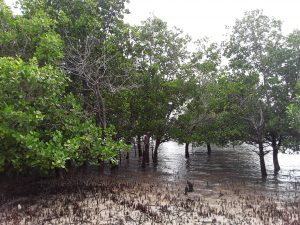
Hardman‑Mountford tells IPS that countries exchange knowledge centred on mangrove protection, management, and sustainability inside the action group. Shared knowledge includes a broad range of topics, including policy, legislation, and regulatory frameworks.
Leveraging on the protective ability of mangroves, Jayakody says that Sri Lanka is actively building its 2nd line of defense force. The land'due south first line of defence, the reefs, were heavily compromised past the deadly 2004 Indian Body of water Tsunami - ane of the worst disasters in modern history, killing about 230 000 people across dozens of countries.
Such was the destruction that the government of Sri Lanka estimated losses of over $1 billion in assets and $330 million in potential output.
Worse yet, approximately 35 000 people died or went missing. In Sri Lanka lonely, property damage included 110 000 houses, of which seventy 000 were destroyed. In all, at to the lowest degree 250 000 families lost their means of support.
Experts say that mangroves have immense capacity to preclude such catastrophes and combat other devastating effects of climate change.
Bolstered by growing scientific evidence, Trinidad and Tobago, the dual-island Caribbean nation, has made significant strides in building its defence using mangroves.
Dr Rahanna Juman, Acting Director at the Constitute of Marine Diplomacy, a government-funded research institute, tells IPS that in 2014, the regime of Trinidad and Tobago commissioned an aerial survey of the country. Using this data, an guess of carbon in mangrove forests beyond the state was ascertained.
"This data illustrated how mangrove and other hardwood forests could showtime emissions and was incorporated into the Greenhouse Gas inventory of Trinidad and Tobago. Chiefly, the survey conclusively demonstrated that mangrove forests store more carbon per hectare than other hardwood forests," Juman expounds.
In 2020, the Institute of Marine Affairs received funding from the British High Committee to fund a mangrove soil carbon cess project involving Guyana, Suriname and Trinidad and Tobago.
Dr Juman indicates that the assessment establish that "the amount of carbon in the mangrove soil was many times larger than the amount of carbon above the footing. This is an assessment that could exist replicated in other Commonwealth countries because nosotros accept developed a low-toll technique of undertaking this of import cess."
Calculation that Mangroves are starting to be incorporated into the Un Reducing Emissions from Deforestation and Forest Degradation (REDD+) programme, which means countries could potentially earn money from protecting and restoring mangroves.
Meanwhile, Hardman‑Mountford cites various challenges in exploring blue carbon because it is all the same an evolving expanse of science and policy.
Sri Lanka understands this challenge all too well. Afterwards the Seismic sea wave, Jayakody says that the government launched vast mangrove restoration projects roofing over two 000 hectares in partnership with other agencies.
Due to limited information on mangroves, she tells IPS that a majority of these projects failed. Undeterred and leveraging on scientific enquiry over the years, Sri Lanka is today a success story in restoring and conserving mangrove comprehend estimated at nineteen 600 hectares.
Other challenges facing countries keen on mangrove blue carbon include a lack of protection for mangroves considering approximately 75 percent of mangrove forests globally remain unprotected and overexploited.
Over the years, Jayakody indicates that mangroves take been at a very high adventure of destruction because their power to prevent coastal erosion, protect shorelines, and provide livelihoods for coastal communities through fisheries was not fully understood.
Hardman‑Mountford agrees, calculation that mangrove forests have declined globally with a loss of between xxx to 50 percentage over the past 50 years from over-harvesting, pollution, agriculture, aquaculture, and coastal development.
The Commonwealth has a huge office to play in reversing this decline.
Overall, there are 47 Commonwealth countries with a coastline.
"Virtually 90 percent of Democracy countries with a coast have mangroves, and at least 38 of these countries with mangroves have provided some level of protection to their mangroves. In all, 16 countries have protected about half or more of their mangroves," he says.
This is a challenge that Sri Lanka is successfully overcoming. With an estimated xl percent of the population in Sri Lanka living along the coastline, Jayakody says that there was an urgent need to protect both livelihoods and coastlines from further degradation.
"In 2015, Sri Lanka established the National Mangrove Expert Commission, and through that, all mangroves were mapped. More so, several new areas were brought nether protection, and in that location have been relentless efforts to better the communities' agreement of the importance of mangrove ecosystem," she says.
Further, Sri Lanka recently validated the Best Practice Guidelines on the Restoration of Mangroves in Sri Lanka and the national mangrove action plan, in line with the mangrove policy adopted in 2020.
Other countries making strides in the right management include the Australian government's involvement with blue carbon and especially ongoing efforts to build capacity in blueish carbon scientific discipline, policy and economics through multi-sectoral partnerships.
"To back up its efforts in blue carbon advocacy and outreach, the Australian government launched the International Partnership for Blue Carbon (IPBC) at the UNFCCC CoP in Paris in 2015," says Ms Heidi Prislan, a Bluish Charter Adviser at the Commonwealth Secretariat.
Commonwealth of australia is also ane of the 28 countries that refer specifically to the mitigation benefits of carbon sequestration associated with littoral wetlands in its National Greenhouse Gas Inventory. In comparison, 59 other countries mention coastal ecosystems as part of their accommodation strategies.
To increase opportunities for blue carbon to participate in the national emissions reduction scheme, the Emissions Reduction Fund, the Australian government has supported research into potential mitigation methodologies that could be implemented to generate carbon credits from domestic projects.
Equally of import, she says that Democracy member countries accept collectively fabricated 44 national commitments to protect or restore mangroves.
Equally the world stares at a catastrophe from the devastating effects of climate change, the massive potential of blueish carbon and, more so, mangrove bluish carbon to eternalize climate change adaptation, mitigation and resilience efforts tin can no longer be ignored.
Follow @IPSNewsUNBureau
Follow IPS News UN Bureau on Instagram
© Inter Press Service (2021) — All Rights Reserved Original source: Inter Press Service
Source: https://www.globalissues.org/news/2021/10/07/28994
0 Response to "what lead to modern mangrove forest replanting efforts."
Postar um comentário